

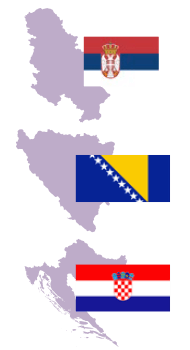
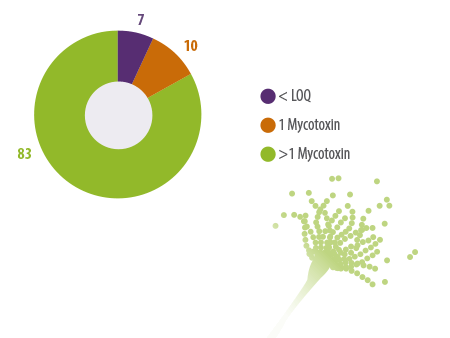
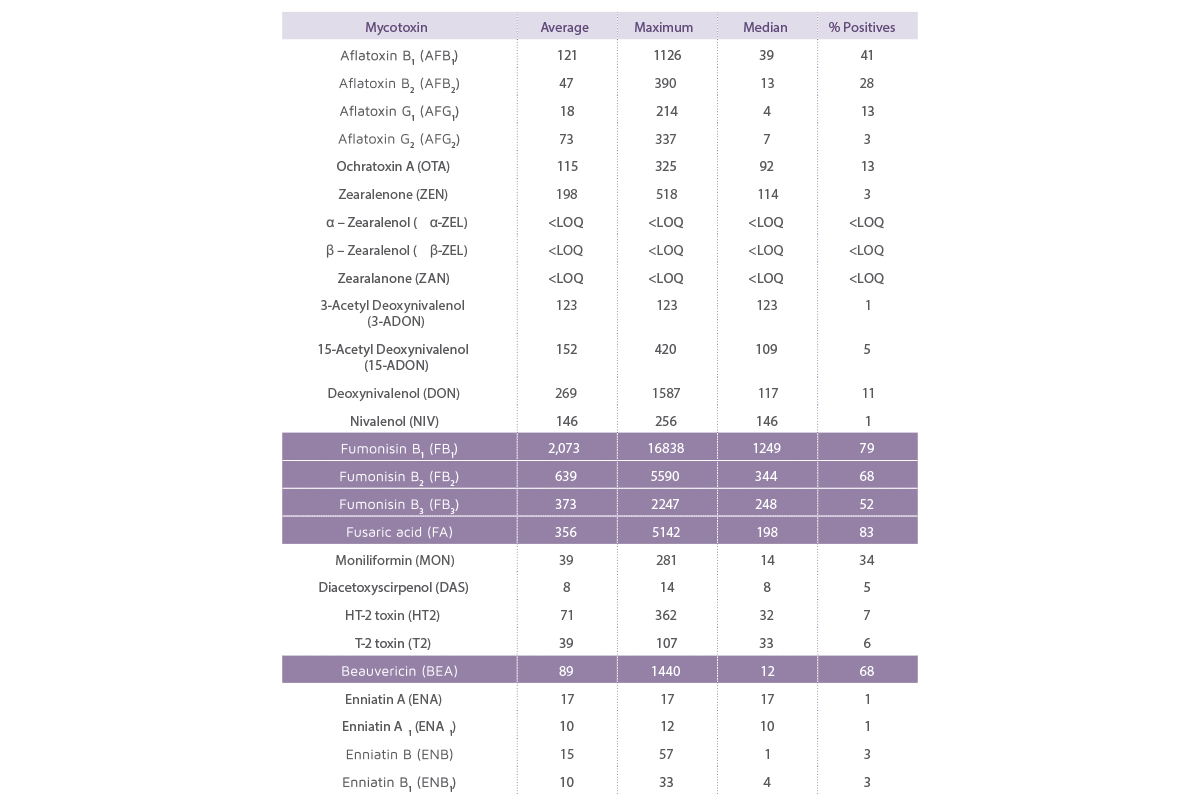
Jog Raj*, Hunor Farkaš, Svetlana Ćujić, Zdenka Jakovčević, Robert Čepela and Marko Vasiljević PATENT CO, DOO., Vlade Ćetkovića 1A, 24 211, Mišićevo, Serbia ⇰ The corn samples from Serbia, Bosnia and Croatia were delivered to PATENT CO’s lab between September 2022 and November 2022. In this survey, 210 corn samples were analysed for multiple mycotoxins by LC-MS/MS triple quadrupole (Agilent 6460 series) using a multi-mycotoxin method for quantification of all mycotoxins present. These included: THE COMBINED RESULTS FOR SERBIA, BOSNIA AND CROATIA ARE SHOWN AS FOLLOWS: In 2022, 7% of the corn samples from Serbia, Bosnia and Croatia were not contaminated with mycotoxins whereas 93% samples were found to contain more one or more than one mycotoxin (Figure 1). Figure 1. Number of mycotoxins per corn sample from Serbia, Bosnia and Croatia. Table 1. Mycotoxin contamination levels (ppb) in corn samples from Serbia, Bosnia, and Croatia in 2022. CONCLUSIONS In the 2022 harvested corn from Serbia, Bosnia, and Croatia, 93% of corn samples were contaminated with one or more than one mycotoxin. ⇰ Fumonisins, Aflatoxins and Beauvericin were the most prevalent mycotoxins detected in these samples using LC-MS/MS. The co-occurrence of more than one mycotoxin can lead to additive or synergistic effects when fed to sensitive animal species (e.g., swine and poultry amongst others).
*Corresponding author: [email protected]
⇰ 3-Acetyl Deoxynivalenol (3-ADON), 15-Acetyl Deoxynivalenol (15-ADON), Deoxynivalenol (DON).
⇰ Nivalenol (NIV).

 This highlights the need for technologies to control mixtures of such contaminants in feedstuffs predominantly based on corn to minimize impacts on animal development.
23/11/22
Initial glimpse of mycotoxin levels in 2022 harvested corn from Southeast Europe



The aim of the present study was to screen corn samples received from different regions of Southeast Europe.
 Micotoxicosis prevention