

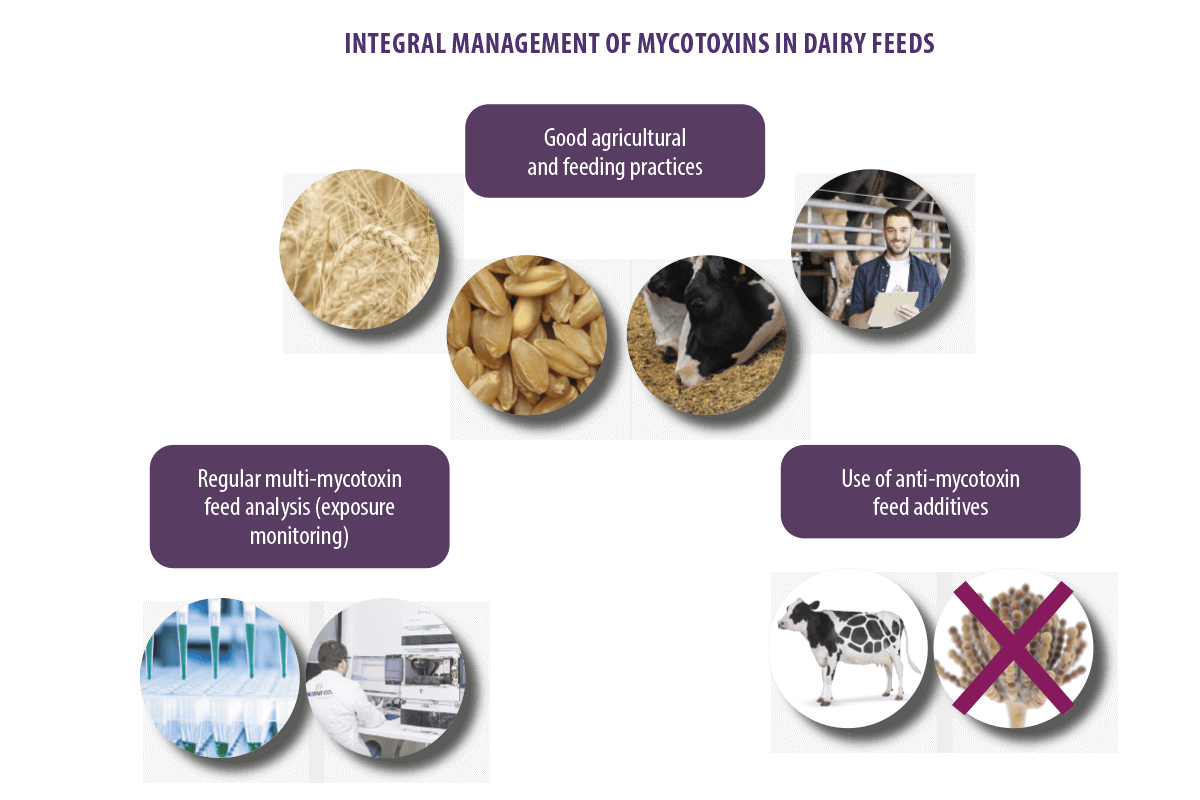
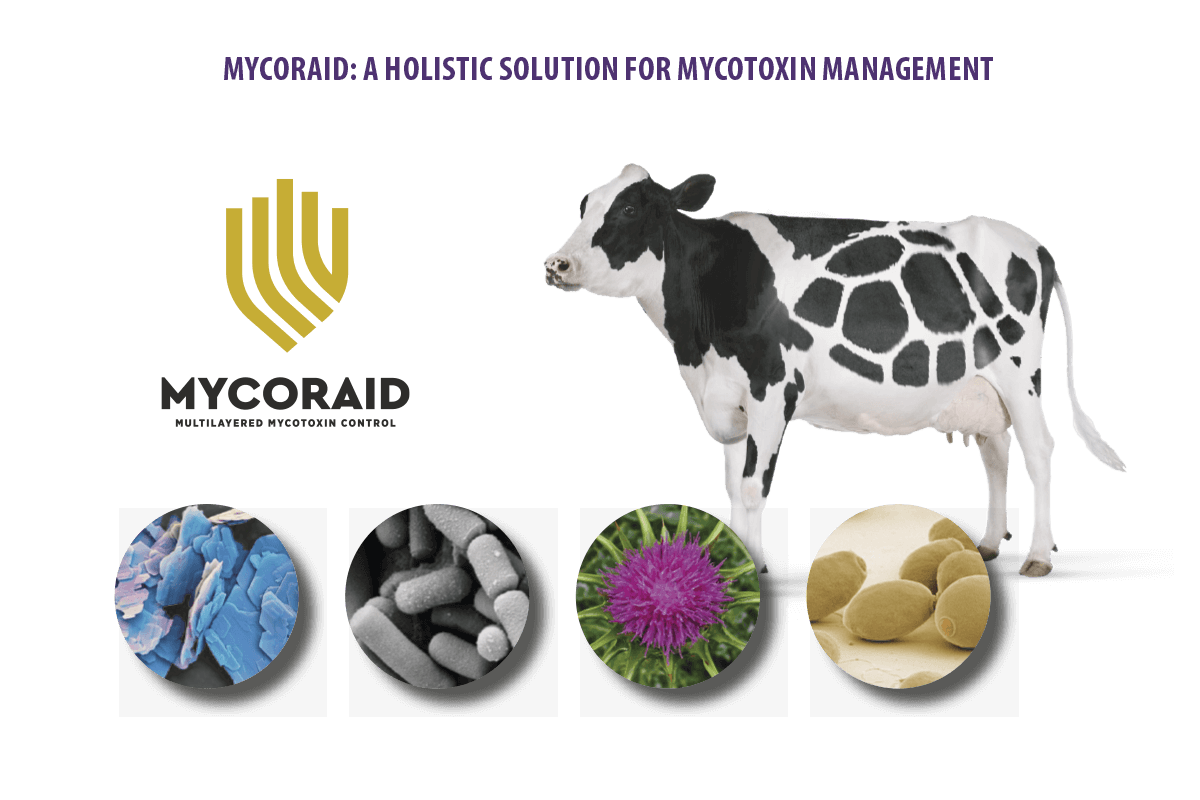
Dr. med. vet. Felipe Penagos-Tabares, DVM Mycotoxins are toxic compounds produced by molds, such as Aspergillus, Alternaria, Fusarium, Penicillium and others. Mycotoxigenic molds can grow on multiple agricultural commodities (e.g. grains, conserved forages [silage and hay] and pastures) (Jouany et al., 2009; Schatzmayr and Streit, 2013; Santos Pereira et., 2019). It has been widely assumed that the resistance of ruminants to mycotoxins is a fact. However, current studies demonstrate that these toxins affect dairy farms performance and profit enormously. Mycotoxins in dairy cow feed: a threat to animal health Current research on mycotoxins clearly shows that dairy cattle are consistently exposed to mixtures of multiple mycotoxins, including aflatoxins, zearalenone (ZEN), deoxynivalenol (DON), fumonisins, enniatins, beauvericin, ergot alkaloids, among others (Penagos-Tabares et al., 2021, 2022a, 2022b, 2023a, 2022b, 2024). Although acute mycotoxicosis is rare in ruminants, chronic exposure to mycotoxins can have multiple impacts on cattle with unspecific effects, representing a real diagnostic challenge for veterinarians, nutritionists, consultants, and farmers (Fink-Gremmels, 2008a). Among the main adverse effects of mycotoxins in cattle are: Moreover, increased prevalence of diseases such as laminitis, mastitis and others have been linked to mycotoxin exposure. AFLATOXIN M1: a hazard for human health and the dairy industry Mycotoxins, such as aflatoxins, can seriously threaten the food safety of dairy products. The hazard starts with feeds contaminated with aflatoxin B1 (AFB1), produced by Aspergillus spp., considered the most potent natural hepatocarcinogenic agent in mammals and classified as a group 1 human carcinogen by the International Agency for Research on Cancer (IARC 2012; Marchese et al. 2018). Once cows ingest AFB1-contaminated feed, they metabolize it into aflatoxin (AFM1), which can appear in milk within hours and persist for several days, even after contaminated feed is removed from their diet (Fink-Gremmels, 2008b). Regulatory agencies, such as the European Union (EU) and the United States Food and Drug Administration (FDA) have set stringent limits on AFM1 levels in milk to protect public health. However, even low levels of AFM1 exposure over time can pose long-term health risks, including liver cancer and immunosuppression. Although other mycotoxins, such as ZEN, DON, fumonisins and emerging mycotoxins, have not been shown to be secreted into milk in large quantities (Fink-Gremmels, 2008b), these toxic compounds can still impact cow health and productivity, reducing milk yield, increasing somatic cell counts, impairing reproduction and compromising overall herd health (Gallo et al., 2015). In addition to the health implications, the economic losses from reduced milk production and treatment costs can be substantial for dairy farmers (Fink-Gremmels. 2008b; Rodrigues, 2014; Santos and Fink-Gremmels, 2014; Gallo et al., 2015). Figure 1. Implications of dietary exposure of mycotoxins in dairy cattle. Integral management of mycotoxins in dairy feed Minimizing exposure to mycotoxin mixtures will protect animal health and optimize performance. Reduction in total aflatoxin intake will reduce both adverse effects on cows and the AFM1 contamination in milk, improving the safety of derived dairy products and protecting the health of human consumers. A holistic mycotoxin management in dairy feeds involves several strategies, such as: Figure 2. Integral management of mycotoxins in dairy feed. MYCORAID: a holistic solution for mycotoxin management MYCORAID is a multi-action mycotoxin control product designed to address the challenges posed by a wide range of mycotoxins, including AFB1, fumonisins, and ZEN. 1. Adsorption MYCORAID integrates specialized minerals, scientifically validated to adsorb a wide range of polar and less polar mycotoxins in the gastrointestinal tract. ⇰ This adsorption prevents the absorption of harmful toxins into the bloodstream. 2. Biotransformation The product includes Bacillus sp., which can biotransform mycotoxins into less harmful compounds. ⇰ This is particularly important for AFB1, as Bacillus can help reduce its conversion to AFM1. 3. Hepatoprotection MYCORAID also contains herbal extracts such as Silymarin from milk thistle (Silybum marianum), which protect the liver from toxin-induced damage. 4. Immunostimulation The cell walls included in MYCORAID are rich in β-glucans and mannan oligosaccharides, which play a pivotal role in immunostimulation. Figure 3. MYCORAID multicomponents. CONCLUSION Compared to monogastric animals, dairy farmers worldwide have neglected and underestimated mycotoxins. The control of mycotoxins in dairy cow feed is not just an animal health and welfare issue but a critical food safety concern with significant economic implications in the global dairy industry. With the growing awareness of the dangers of AFM1 in milk, farmers must take proactive steps to minimize mycotoxin contamination in their dairy cow diets. References Boudergue et al. 2009. Review of mycotoxin-detoxifying agents used as feed additives: mode of action, efficacy and feed/food safety. EFSA Supporting Publications, 6(9), 22E. European Commission (EC). 2023. Commission Regulation (EU) 2023/915 of 25 April 2023 on maximum levels for certain contaminants in food and repealing Regulation (EC) No 1881/2006. Fink-Gremmels, J., 2008a. The role of mycotoxins in the health and performance of dairy cows. Vet J 176, 84-92. Fink-Gremmels. 2008b. Mycotoxins in cattle feeds and carry-over to dairy milk: A review. Food Addit Contam Part A Chem Anal Control Expo Risk Assess 25, 172-180. Gallo et al., 2015. Review on mycotoxin issues in ruminants: Occurrence in forages, effects of mycotoxin ingestion on health status and animal performance and practical strategies to counteract their negative effects. Toxins, 7(8), 3057-3111. IARC (International Agency for Research on Cancer) 2012. Agents classified by the IARC Monographs, 446, 1-106. http://monographs. iarc.fr/ENG/Classification/index. php. Jard et al. 2011. Review of mycotoxin reduction in food and feed: from prevention in the field to detoxification by adsorption or transformation. Food Additives & Contaminants: Part A, 28(11), 1590-1609. Jouany et al. 2005. Effects of mycotoxins in ruminants. In: Diaz, D. (Ed.) The mycotoxin blue book, Nottingham University Press. Nottingham, UK. 295-321. Jouany et al. 2009. Risk assessment of mycotoxins in ruminants and ruminant products. Options mediterranéennes, A 85, 205-224. Marchese et al., 2018. Aflatoxin B1 and M1: biological properties and their involvement in cancer development. Toxins 10:214. Marin and Taranu. 2023. Food and Feed Additives to Counteract Mycotoxin Toxicity in Human and Animals. Sustainable Use of Feed Additives in Livestock: Novel Ways for Animal Production, 351-375. Muñoz-Solano et al. 2024. Monitoring Mycotoxin Exposure in Food-Producing Animals (Cattle, Pig, Poultry, and Sheep). Toxins, 16(5), 218. Penagos-Tabares et al. 2021. Mycotoxins, Phytoestrogens, and Other Secondary Metabolites in Austrian Pastures: Occurrences, Contamination Levels, and Implications of Geo-climatic Factors. Toxins 13. Penagos-Tabares et al. 2022a. Fungal species and mycotoxins in mouldy spots of grass and maize silages in Austria. Mycotoxin Research, 1-20. Penagos-Tabares et al. 2022b. Cocktails of Mycotoxins, Phytoestrogens, and Other Secondary Metabolites in Diets of Dairy Cows in Austria: Inferences from Diet Composition and Geo-Climatic Factors. Toxins 14, 493. Penagos-Tabares et al. 2023a. Co-occurrence of mycotoxins and other fungal metabolites in total mixed rations of cows from dairy farms in Punjab, Pakistan. Mycotoxin Research, 39(4), 421-436. Penagos-Tabares et al., 2023b. Mixtures of mycotoxins, phytoestrogens, and other secondary metabolites in whole-plant corn silages and total mixed rations of dairy farms in central and northern Mexico. Toxins, 15(2), 153. Penagos-Tabares et al. 2024. Outbreak of aflatoxicosis in a dairy herd induced depletion in milk yield and high rates of abortion in Pakistan. Toxicon, 107799. Rodrigues et al., 2019. Feed additives containing sequestrant clay minerals and inactivated yeast reduce aflatoxin excretion in milk of dairy cows. J Dairy Sci 102, 6614-6623. Rodrigues. 2014. A review on the effects of mycotoxins in dairy ruminants. Anim Prod Sci 54, 1155-1165. Santos and Fink-Gremmels. 2014. Mycotoxin syndrome in dairy cattle: characterisation and intervention results. World Mycotoxin J 7, 357-366. Santos Pereira, et al. 2019. Prevalent mycotoxins in animal feed: Occurrence and analytical methods. Toxins 11, 290. Schatzmayr et al. 2013. Global occurrence of mycotoxins in the food and feed chain: facts and figures. World Mycotoxin J 6, 213-222. Yuan et al. 2015. Yeast product supplementation modulated humoral and mucosal immunity and uterine inflammatory signals in transition dairy cows. Journal of dairy science, 98(5), 3236-3246. Zentai et al., 2023. Carry-over of aflatoxin B1 from feed to cow milk—a review. Toxins 15 (3), 195.
Luis-Miguel Gomez-Osorio, DVM, MSc, PhD Although moulds and mycotoxins are ubiquitous, high humidity and improper storage practices can exacerbate the level of contamination of feed and animal-derived food (especially dairy products!) (Fink-Gremmels, 2008).
 Dairy farmers worldwide still underestimate the negative consequences of mycotoxins (Fink- Gremmels, 2008a; Rodrigues, 2014).
 Such “mycotoxin cocktails” can induce adverse effects in the dairy industry.
 The mentioned disturbances in the physiological status of the cows will be reflected in reduced milk production, poor growth performance, and higher veterinary costs, which will reduce the economic profits of dairy farms (Gallo et al., 2015).
 The carry-over rates from feed to milk range from 1 to 6% of AFB1 to AFM1 (Zentai et al., 2023).
 Since milk is a staple in many diets, including infants and children, AFM1 represents a critical risk to food
safety, particularly in populations dependent on dairy as a dietary staple.
 The EU, for example, has established that the maximum allowable level of AFM1 is 0.05 μg/kg in raw milk (EC, 2023).
 Signs of mycotoxin exposure in cows can range from subtle and unspecific issues like decreased appetite and weight loss to more severe problems such as liver damage, immunosuppression,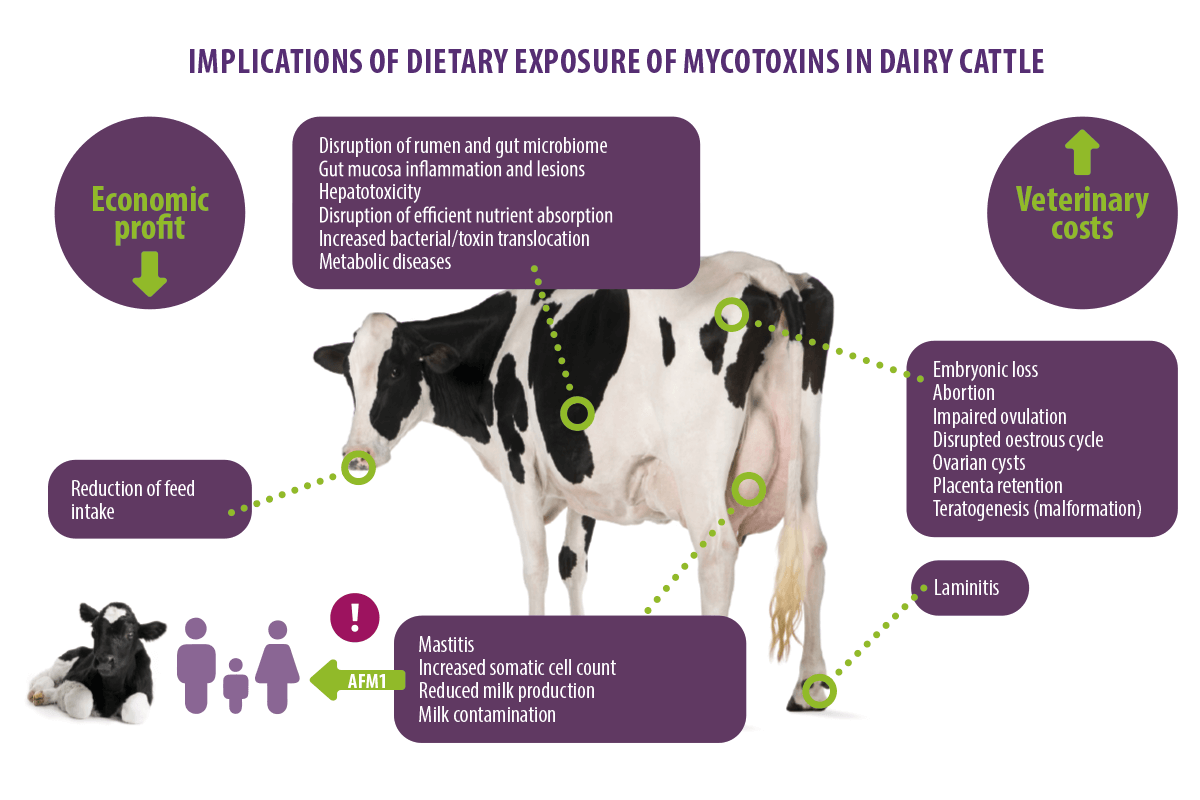
(exposure monitoring): since mycotoxicoses are a diagnostic challenge and commercial biomarkers are usually unavailable, analyzing feeds/rations for mycotoxin contamination is crucial for mycotoxin management. Regular feed analysis is ideal for objective monitoring and risk assessment, especially during high-risk periods such as wet seasons and summer (in temperate regions) (Penagos-Tabares et al., 2022b; Muñoz-Solano et al., 2024).
 It offers several protection mechanisms through adsorption, biotransformation, and immune support.
 Its proven efficacy in adsorbing and detoxifying mycotoxins and its ability to support gut health and immunity make it essential for maintaining high milk quality standards and meeting regulatory requirements.
29/11/24
Mycotoxin management in dairy cows: enhancing health, performance and milk safety


Controlling mycotoxins in dairy cows is key to ensuring safe dairy products and protecting animal health.
AFB1 can also seriously impact dairy herd health, production, and reproduction, with severe economic effects (Zentai et al., 2023, Penagos-Tabares et al., 2024).
This promotes overall gut health and supports a robust immune system, reducing the immunosuppressive effects caused by mycotoxin exposure (Yuan et al., 2015).
MYCORAID offers an integral and multi-target solution by reducing the absorption and toxicity of multiple mycotoxins, thus ensuring healthier cows and safer milk for human consumption.
By using MYCORAID, dairy farmers can reduce the risk of mycotoxins entering the milk, thereby safeguarding both animal health and human food safety.
 Micotoxicosis prevention