





BACKGROUND
 Aflatoxin B1 (AFB1) is a highly regulated mycotoxin worldwide and is considered one of the most economically important mycotoxins due to its high prevalence and significant negative effects on animal performance.
 It is mainly produced by Aspergillus flavus and Aspergillus parasiticus in corn, wheat, oats, and other agriculturally important crops.
OBJECTIVE
 The aim of this study was to isolate an AFB1-degrading microorganism from an environmental sample using an enrichment culture procedure.
MATERIALS Y METHODS
In this study, an AFB1-degrading microbe was isolated from an environmental sample using an enrichment culture procedure with Inorganic Salt Culture medium (ISC) and a mixture of mycotoxins (AFB1, FB1, DON, ZEN, OTA, T-2/HT-2), each at a concentration of 1 ppm, as the sole carbon source. After the first round of enrichment, the level of AFB1 was reduced and in the next round, only 1 ppm of AFB1 was added. The procedure was repeated multiple times, and samples were collected after 24 and 48 hours for LC-MS/MS analysis of AFB1.
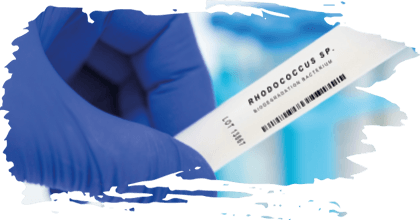
 The isolated microbe was identified as Rhodococcus sp. by NCIMB Ltd., UK.
RESULTS
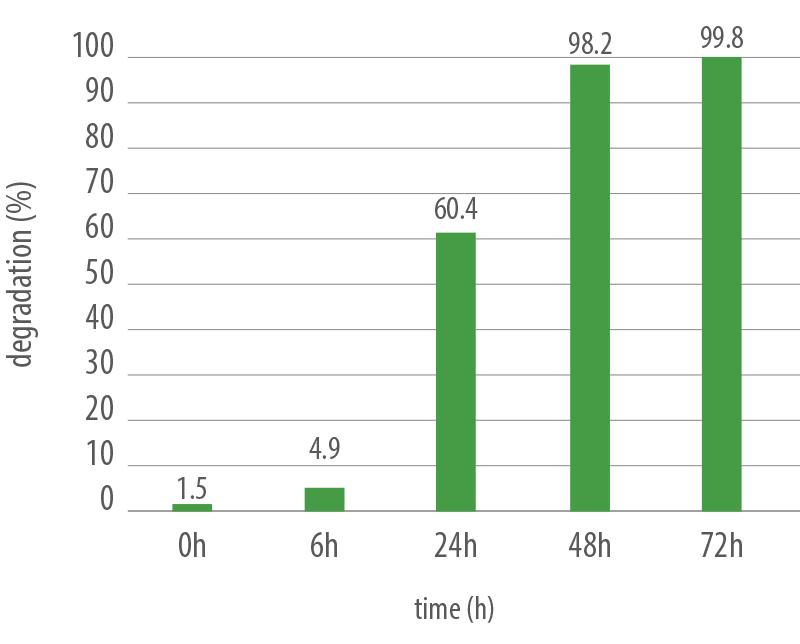
The optimum temperature for AFB1 degradation is 30° C, and the optimum pH ranges from 5 to 7 (Figura 1). Figure 1. Optimum pH for AFB1 degradation by Rhodococcus sp. Rhodococcus sp. (1.2 × 10⁸ CFU/ml) degraded 60.4 % and 98.2 % of 1 ppm AFB1 after 24 and 48 hours, respectively, in ISC medium (Figure 2). Figure 2. Time course of AFB1 degradation (%) by Rhodococcus sp. Rhodococcus sp. degraded 19.1 % of 1 ppm AFB1 extracted from naturally contaminated corn when cultured in ISC medium for 48 hours.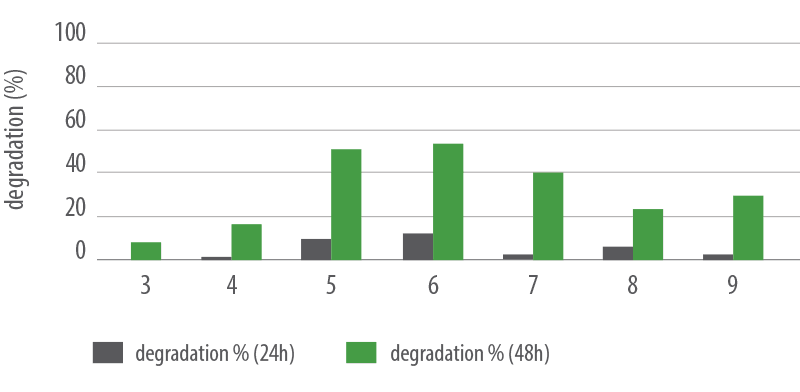
Thermostability tests showed that Rhodococcus sp. remained viable after a 3-minute treatment at 80–90°C in the dried state. The metabolite(s) produced during AFB1 biotransformation could not be identified. The effect of Rhodococcus sp. concentration (CFU/ml) on the degradation rate was not evaluated separately. However, based on the results:
CONCLUSIONS
Authors
Jovana Dubajić, Zdenka Jakovčević, Hunor Farkaš, Jog Raj* and Marko Vasiljević
PATENT CO. DOO Mišićevo, operating under A&P Nutrition trademark on the international markets, Vlade Ćetkovića 1A, 24 211, Mišićevo, Serbia.
*Corresponding author: [email protected]
47th Mycotoxin Workshop. Berlin, Germany, June 01–03, 2026
 Micotoxicosis prevention