

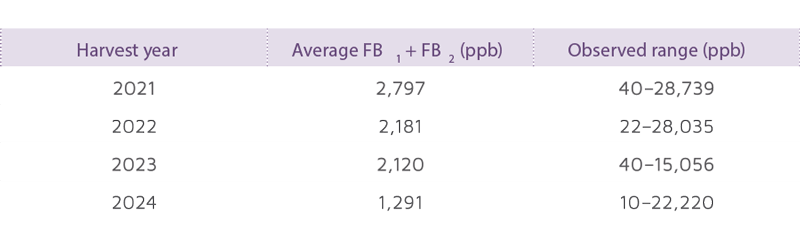
Jog Raj, Hunor Farkaš, Miladin Dogan, Svetlana Ćujić, Goran Grubješić, Jovana Dubajić, Zdenka Jakovčević and Marko Vasiljević Mycotoxins are toxic secondary metabolites produced by moulds that can contaminate feed ingredients before harvest, during storage, or throughout feed processing. Their occurrence is strongly influenced by: Even when individual toxins are present at moderate concentrations, simultaneous exposure to multiple mycotoxins can increase biological stress and complicate risk assessment under commercial conditions. Fumonisins are among the most important mycotoxins associated with maize and maize-based feed materials. They are mainly produced by Fusarium verticillioides and Fusarium proliferatum, with fumonisin B1 and fumonisin B2 being the most frequently detected forms in feed. Their toxic action is linked to the disruption of the animal’s sphingolipid metabolism through the inhibition of ceramide synthase, which can affect: In poultry, fumonisin exposure has been associated with: FOUR YEARS OF GLOBAL FUMONISIN MONITORING IN CORN FOR ANIMAL FEED The monitoring included corn samples collected from 20 countries across Africa, the Americas, Asia, and Europe: Corn samples were analyzed using an LC-MS/MS triple quadrupole system (Agilent 6460 series) with the multi-mycotoxin method described by Farkas et al. (2025). Results were expressed in μg/kg (equivalent to parts per billion, ppb) and adjusted to a feed moisture content of 12%. Descriptive statistical analyses were used to summarize fumonisin prevalence and concentration ranges by harvest year. RESULTS AND DISCUSSION: GLOBAL TRENDS IN FUMONISIN CONTAMINATION The results showed that fumonisins were detected in 80–90% of corn samples between 2021 and 2024. ⇒ This high detection rate confirms that fumonisin contamination is not an occasional finding but a frequent and globally relevant issue in corn. Average fumonisin concentrations were: Although average concentrations declined over the four-year period, the yearly means remained above 1,000 ppb, which is particularly important considering the recently revised poultry reference point for adverse intestinal effects (EFSA, 2022). Table 1. Average concentrations and observed ranges of fumonisins (FB₁ + FB₂) in corn harvested between 2021 and 2024. The broad concentration ranges observed in each harvest year underline the uneven distribution of fumonisins in corn and the limitations of relying solely on visual grain quality or regional assumptions. In 2021, concentrations ranged from 40 to 28,739 ppb, while similarly wide ranges were observed in 2022 (22–28,035 ppb), 2023 (40–15,056 ppb), and 2024 (10–22,220 ppb). From a poultry production perspective, these findings are highly relevant. CONCLUSIONS The monitoring of corn harvested between 2021 and 2024 across 20 countries demonstrated a consistently high prevalence of fumonisins, with positive findings in 80–90% of samples. Although average concentrations decreased over the monitoring period, all yearly averages remained above 1,000 ppb, highlighting the continued importance of fumonisin control in poultry nutrition. The large variation between minimum and maximum concentrations further confirms that batch-specific testing is essential for accurate risk assessment and management. For poultry producers and feed manufacturers, these results support the need for: Because fumonisins can affect intestinal health and interact with other mycotoxins, feed safety programs should combine: REFERENCES EFSA CONTAM Panel. (2022). Assessment of information as regards the toxicity of fumonisins for pigs, poultry and horses. EFSA Journal, 20(8), 7534. https://doi.org/10.2903/j.efsa.2022.7534 Farkas et al. (2025). 46th Mycotoxin Workshop, May 25–28, 2025, Martina Franka, Italy.
PATENT CO. DOO., operating under A&P Nutrition trademark on the international markets, Vlade Ćetković 1A, 24211, Mišićevo, Serbia
 Crop typeWeather conditionsAgronomic practicesInsect damageDrying efficiencyStorage hygiene
 Because poultry diets often contain a high proportion of cereal grains and cereal by-products, mycotoxin contamination remains a continuous challenge for feed safety, animal health, and production profitability.
 Impaired intestinal morphologyAltered sphingolipid profilesReduced barrier functionImmune modulationPoor performance under challenge conditionsIncreased sensitivity to other stressors
 The aim of the present study was to determine the occurrence and concentrations of fumonisins B1 and B2 (FB1 + FB2) in corn harvested between 2021 and 2024.
 This approach is particularly relevant for feed manufacturers and poultry producers because contamination data should be interpreted not only in terms of average toxin concentrations but also according to the frequency of positive samples and the occurrence of high-risk outliers.
 Corn is a major energy source in many broiler and layer diets, and high inclusion rates can translate contaminated raw materials into substantial dietary exposure.Fumonisins may compromise intestinal development and function, which is particularly important in fast-growing broilers, where efficient nutrient absorption and gut integrity are essential for optimal feed conversion, litter quality, and resilience against enteric challenges.Fumonisins frequently co-occur with other Fusarium mycotoxins, such as deoxynivalenol and zearalenone, meaning that birds may be exposed to combined toxicological pressure rather than to a single isolated contaminant.
 Routine mycotoxin analysisCareful evaluation of corn batchesIntegrated mitigation strategies
Raw material monitoringInformed feed formulationProper storage managementAppropriate nutritional or technological interventions where a risk has been identified
15/07/26
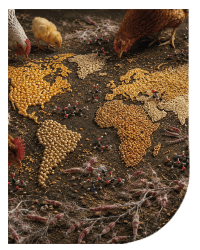
Occurrence of fumonisins in corn harvested during 2021-2024 from different countries across Africa, The Americas, Asia, and Europe



Fumonisins remain highly prevalent in corn intended for animal feed, underscoring the importance of monitoring them.
Recent scientific evaluations have highlighted intestinal effects in poultry as particularly relevant, with a reference point for adverse animal health effects of 1 mg/kg feed for fumonisins.
This broad geographical coverage provides a practical overview of fumonisin contamination in corn used for animal nutrition and allows year-to-year trends to be compared across multiple regions.
These results show that even in years with lower average contamination, individual batches may still contain fumonisin concentrations high enough to represent a significant risk for poultry feed formulation.
Regular surveillance remains the most reliable basis for protecting poultry health, maintaining performance, and reducing the economic impact of contaminated feed.
 Micotoxicosis prevention