





BACKGROUND
 Mycotoxins are secondary metabolites produced by filamentous fungi that often play an important role in plant pathogenesis and spreading of fungal infection.
T-2 and HT-2 toxins are type-A trichothecenes produced by different Fusarium species. ⇰ T-2 toxin is rapidly metabolized to HT-2 toxin which is also the main metabolite in vivo (Eriksen y Alexander, 1998; Visconti, 2001). Fusarium langsethiae, F. poae and F. sporotrichioides are the predominant species that invade cereal crops and produce T-2 and HT-2 toxins under cool and moist conditions in the field (Krska, 2014). T-2 and HT-2 toxins are produced under conditions that are not optimal for the growth of these moulds (Hodgson, 2000). Various studies propose different temperatures to be optimal for trichothecene production.
 Mateo (2002) reported that 20 °C was the most suitable for trichothecene production in general.Medina (2010) found 20–30 °C as optimal range for F. langsethiae.Nazari (2013) reported 15 °C for F. langsethiae as the optimal temperatures for T-2 and HT-2 production.
OBJECTIVE
 In this small-scale experiment, the effect of different moisture levels on T-2 and HT-2 toxin production — and on the changing ratio between both toxins — by the Fusarium langsethiae strain Fe2391 was evaluated.
MATERIALS & METHODS
The mould was cultivated on 100 g of whole wheat grains in 450 ml aluminium trays (130 × 105 × 40 mm). The samples were incubated for 14 days at 20 °C. The wheat was inoculated with one-sixth of a mould culture grown on potato dextrose agar in a 90 mm Petri dish.
 Three moisture levels were tested by adding 30 ml, 40 ml, and 50 ml of tap water and leaving the samples to soak overnight.
The samples were covered with aluminium foil, and in half of them the foil was perforated to test the effect of allowing water to evaporate from the sample. At the end of the incubation period, the cultures were dried in a drying oven, milled, and the T-2 and HT-2 toxin yields were quantified using LC-MS/MS. All experiments were carried out with one sample per treatment.
RESULTS
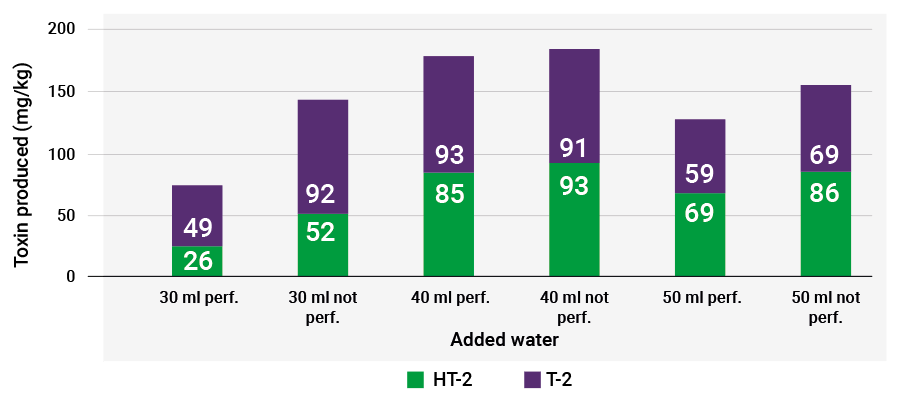
The results revealed a trend in T-2 and HT-2 toxin production and in their changing ratio (FigurE 1). Figure 1. T-2/HT-2 toxin ratio. The highest total toxin level was recorded at 40 ml of added water in both the perforated and non-perforated foil samples, with equal levels of T-2 and HT-2 produced. Perforating the aluminium foil only affected T-2 and HT-2 production significantly when 30 ml of water was added, resulting in a 47.9 % decrease in total toxin production. In samples with 40 ml and 50 ml of added water, perforating the foil decreased total toxin production by 3.3 % and 17.4 %, respectively (Figure 2). Figura 2. T-2/HT-2 toxin production.
Samples with 30 ml of added water showed the highest T-2/HT-2 toxin ratios (1.88 and 1.77).In samples with 40 ml of added water, the ratio decreased (1.09 and 0.98).Adding 50 ml of water inverted the T-2/HT-2 ratio (0.86 and 0.80).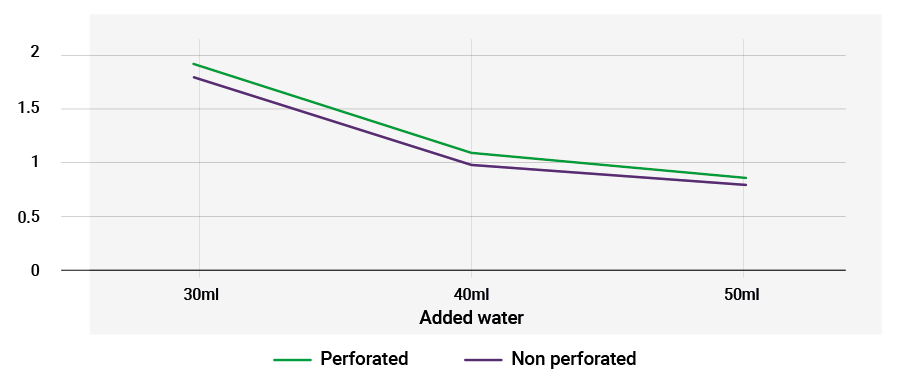
CONCLUSIONS
 Although it was a small-scale test, the results indicate that the T-2/ HT-2 toxin production ratio differed depending on the amount of water added to the substrate. Allowing water to evaporate only affected toxin production in the samples with the least amount of added water.
REFERENCES
Eriksen, G. S., Alexander, J. (ed.) “Fusarium toxins in cereals: A risk assessment.” Nordic Council of Ministers (1998): 7-44.
Hodgson, D. A. “Primary metabolism and its control in streptomycetes: A most unusual group of bacteria.” Adv. Microb. Physiol. 42 (2000): 47-238.
Krska, R., Malachova, A., Berthiller, F., van Egmond, H. P. “Determination of T-2 and HT-2 toxins in food and feed: An update.” World Mycotoxin Journal 7, no. 2 (2014): 131-142.
Mateo, J. J., Mateo, R., Jimenez, M. “Accumulation of type A trichothecenes in maize, wheat and rice by Fusarium sporotrichioides isolates under diverse culture conditions.” International Journal of Food Microbiology 72, no. 1-2 (2002): 115-123.
Medina, A., Magan, N. “Temperature and water activity effects on production of T-2 and HT-2 by Fusarium langsethiae strains from north European countries.” Food Microbiology 28, no. 3 (2011): 392-398.
Nazari, L., Pattori, E., Terzi, V., Morcia, C., Rossi, V. “Influence of temperature on infection, growth, and mycotoxin production by Fusarium langsethiae and F. sporotrichioides in durum wheat.” Food Microbiology 39 (2014): 19-26.
Visconti, A. “Problems associated with Fusarium mycotoxins in cereals.” Int. J. Agric. Sci. 9 (2001): 39-55.
 Micotoxicosis prevention