




Mycotoxins are secondary metabolites produced by fungi that can contaminate a wide range of agricultural products worldwide. Among the most common and well-known mycotoxins are: These mycotoxins have been identified as harmful to swine health. These toxic compounds pose a significant risk to human and animal health.
 Aflatoxins (such as AFB1 y AFB2)Deoxynivalenol (DON, also known as vomitoxin)Fumonisins (FB1, FB2)Ochratoxin A (OTA)T-2 and HT-2 toxinsZearalenone (ZEN)
 These mycotoxins are referred to as regulated mycotoxins because their maximum permissible concentrations or guidelines in animal feed are defined by the EU and multiple state authorities.
The impact of mycotoxins on the growth of piglets and fatteners, as well as on sow fertility and reproductive performance, is well documented, with many studies highlighting the various negative outcomes associated with mycotoxin exposure.
Diagnosis can be challenging due to vague symptoms and the presence of mycotoxins below detection limits. To make matters worse, the so-called emerging mycotoxins are even less frequently analyzed, as they require sophisticated analytical devices for detection and regulatory limits are lacking. Since mycotoxins cannot be removed from animal feed once they have been produced, a common strategy is to support the animals with anti-mycotoxin feed additives. The functional components of a good holistic mycotoxin management product include: MYCORAID - MULTILAYERED PROTECTION Some emerging mycotoxins are known to negatively affect swine.

MYCORAID is a specialized product designed for multilayered protection that contains: In an in vitro test, MYCORAID was highly effective against mycotoxins (Figure 1) and provided rapid and irreversible deactivation.
 Specially selected minerals
Bacterial components
Yeast cell wall ingredients
Selected herbal extracts Efficiency is defined as the proportion of adsorbed mycotoxins (pH 3.0) minus the desorbed proportion (pH 6.5).
Figure 1. MYCORAID shows high efficacy in an in vitro test. To test the effectiveness of MYCORAID under practical conditions, a scientific experiment was conducted at the Freie Universität Berlin with weaned piglets aged 25 to 66 days (Raj et al., 2025).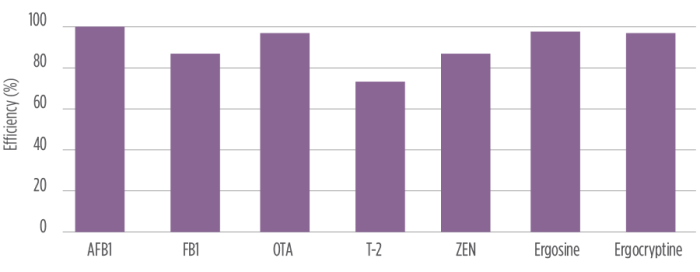
The piglets were exposed to the common mycotoxins:
DON (1000 ppb): typically known to cause reduced feed intake and, in extreme cases, feed refusal.ZEN (800 ppb): it has direct effects on reproductive performance, such as irregular heats, abortion, pseudopregnancy, low conception rates, ovarian cysts, embryonic loss, nymphomania, uterine hypertrophy, hyperestrogenism, agalactia, stillbirths, and infertility.
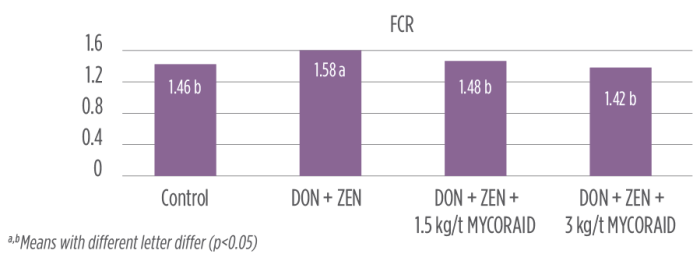
In the trial, mycotoxin exposure of the piglets had significant negative effects on: The total Feed Conversion Ratio (FCR) for piglets aged 25 to 66 days fed the control diet was 1.46. ⇒ Exposure to DON and ZEN significantly increased the FCR (1.58; +8.8 %), whereas harmful effects of mycotoxins on this parameter were completely mitigated by MYCORAID (Figure 2). Figure 2. MYCORAID mitigated the increase in FCR during mycotoxin contamination. The total weight of the ovary, uterine horn, and vaginal vestibule was measured. The relative weights of the reproductive organs (% body weight) were significantly affected by exposure to ZEN. ⇒ Due to its estrogenic activity, ZEN alters the relative weights of these organs. Female piglets exposed to DON and ZEN showed a significant increase in the relative weights of the reproductive organs. Figure 3. MYCORAID mitigated the ZEN-induced growth of the female reproductive organs.
 Growth parameters (feed intake, final weight, feed efficiency) Blood count Inflammatory biomarkers Relative liver weight Relative weight of the reproductive organs due to the estrogenic effect of ZEN
 The use of MYCORAID mitigated the negative effects of DON and ZEN and brought most of the tested parameters back to control levels.
 MYCORAID reduced these weights and, at higher doses, restoring them to levels comparable to the control group (Figure 3).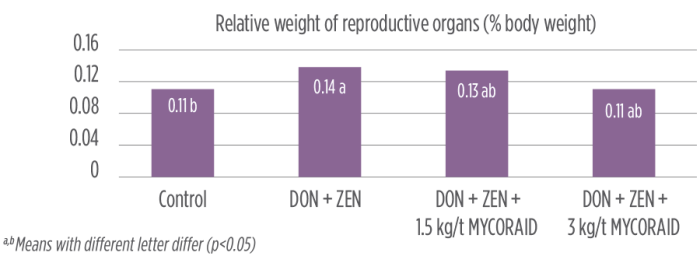
 These results show that MYCORAID was effective in the adsorption and bacterial biotransformation of mycotoxins in the present trial and that it supported the health of the piglets.
CONCLUSION Mycotoxins are an increasingly serious problem as their prevalence and concentration in feed continue to rise. Good mycotoxin management is key to preventing performance losses and health problems.
References Raj, J., Tassis, P., Männer, K., Farkaš, H., Jakovčević, Z., & Vasiljević, M. (2025). Effects of a Multicomponent Mycotoxin Detoxifying Agent on Health and Performance of Weaned Pigs Under Combined Dietary Exposure to Deoxynivalenol (DON) and Zearalenone (ZEN). Toxins, 17(3), 146. https://doi.org/10.3390/toxins17030146
 Micotoxicosis prevention