

Anawach Phuengkasem The swine industry has managed mycotoxin contamination as a risk to be addressed at the level of individual mycotoxins. While this approach is not theoretically wrong, this single-mycotoxin logic is no longer relevant in modern swine production. Modern analytical methods consistently reveal that pigs are not exposed to only one mycotoxin at a time, but rather to combinations of multiple mycotoxins that: Climate variability in Southeast Asia and warm storage conditions create ideal environments for the proliferation of Aspergillus, Fusarium, and Penicillium species. This article draws on two peer-reviewed abstracts that will be presented at the International Pig Veterinary Society Congress 2026 (IPVS 2026), supported by published in vivo research and regional surveillance data, to: REGIONAL EVIDENCE The regional comprehensive mycotoxin surveillance study was conducted on wheat, soybean meal, DDGS, and finished swine feed samples collected from different regions of Thailand and Vietnam throughout 2025 using LC-MS/MS. The findings reveal a severe picture of contamination at the farm level (IPVS 2026, abstract #231). Table 1. Mycotoxin contamination levels (ppb) in wheat samples from Thailand and Vietnam (Jan-Nov 2025). Table 2. Mycotoxin contamination levels (ppb) in DDGS samples from Thailand and Vietnam (Jan-Nov 2025). Table 3. Mycotoxin contamination levels (ppb) in swine feed samples from Thailand and Vietnam (Jan-Nov 2025). The co-occurrence of multiple mycotoxins has significant consequences for both food and feed safety, since combined exposure can produce synergistic effects that increase health risks in animals and, through tissue residues, in humans. WHY DOES CO-OCCURRENCE MATTER? Regulatory frameworks for mycotoxins in the European Union and many Southeast Asian countries are largely built around single-mycotoxin thresholds. Published literature reveals the synergistic effects of DON and ZEN on the immune system, liver function, and oxidative stress in pigs. The combination of fumonisins (FUM) with DON or ZEN has shown synergistic effects in several animal studies. AFB1 and OTA are among the most extensively studied synergistic combinations, with combined administration demonstrating clearly higher nephrotoxicity than either mycotoxin alone (Aoyanagi et al., 2023; Papatsiros et al., 2023). According to the 2024 World Mycotoxin Survey, approximately 70 % of feed samples worldwide contained two or more mycotoxins, with ZEN contamination rising from 54 % in 2023 to 60 % in 2024. CAN DETOXIFICATION WORK? Once multi-mycotoxin contamination is confirmed, the operational question for integrators and feed producers is whether effective mitigation is achievable. ⇒ The answer has historically been complicated by the limitations of single-mechanism approaches. Simple clay-based adsorbents work reasonably well for aflatoxins, which carry a high charge density and bind effectively to polar mineral surfaces. However, they show limited or variable efficacy against trichothecene mycotoxins such as DON and T-2, as well as against ZEN, FUM, and OTA. Two categories of action exist within commercial mycotoxin detoxifiers: IN VIVO VALIDATION IN PIGS A series of five controlled in vivo trials in pigs conducted by Aristotle University of Thessaloniki (IPVS 2026, abstract #411) provides some of the most comprehensive evidence currently available for MMDA efficacy under multi-mycotoxin conditions. MYCORAID, a specific MMDA containing modified zeolite (clinoptilolite), probiotics, yeast cell wall, and herbal extracts, was supplemented at 1.5 or 3 kg per ton of feed across five different mycotoxin challenge scenarios. Table 4. Summary of five in vivo pig trials evaluating the efficacy of MYCORAID under different multimycotoxin challenge conditions (IPVS 2026, abstract #411). Reductions in mycotoxin residues in tissues were also demonstrated across all five challenge models. The 53.3 % reduction in T-2 kidney residues and the 26.8 % reduction in ZEN and its metabolites in liver samples are particularly significant from both food safety and animal health perspectives. These findings are supported by technical publications from the same research group. WHY IS MYCORAID REQUIRED? The regional mycotoxin surveillance data and the five MYCORAID trials collectively illustrate a key principle: No single mycotoxin binder can effectively address the full spectrum of contaminants. The success of MYCORAID supplementation in pig diets can be scientifically explained by the contribution of each component through different mechanisms, including: A published in vivo study on sow health confirmed that MYCORAID supplementation reduced key biomarkers of oxidative stress, including thiobarbituric acid reactive substances (TBARS) and protein carbonyls, while improving clinical and reproductive parameters on farms with naturally contaminated feed. PRACTICAL APPLICATIONS For feed millers and feed integrators sourcing DDGS or wheat in Thailand and Vietnam, incorporating MYCORAID at 3 kg/ton of feed represents a cost-effective and evidence-based protective strategy. For veterinarians managing health outcomes on commercial farms, the tissue residue data are particularly relevant. Unlike single-component binders, which may require different products for different mycotoxin profiles, MYCORAID provides consistent coverage regardless of the specific combination of mycotoxins present in the feed. CONCLUSION Multi-mycotoxin co-contamination is the norm in Southeast Asian swine diets. The solution requires a multicomponent detoxifying agent capable of matching the scale of the problem. The data supporting these recommendations are now robust, field-relevant, and regionally specific, and the tools to act on them are available. References Aoyanagi, M. M. C. C., Budiño, F. E. L., Raj, J., Vasiljević, M., Ali, S., Ramalho, L. N. Z., Ramalho, F. S., Corassin, C. H., Ghantous, G. F., and Oliveira, C. A. F. 2023. Efficacy of Two Commercially Available Adsorbents to Reduce the Combined Toxic Effects of Dietary Aflatoxins, Fumonisins, and Zearalenone and Their Residues in Tissues of Weaned Pigs. Toxins (Basel). 15(11):629. https://www.ncbi.nlm.nih.gov/pmc/articles/PMC10675588/ Papatsiros, V. G.; Eliopoulos, C.; Voulgarakis, N.; Arapoglou, D.; Riahi, I.; Sadurní, M.; and Papakonstantinou, G.I. 2023. Effects of a Multi-Component Mycotoxin-Detoxifying Agent on Oxidative Stress, Health and Performance of Sows. Toxins. 15:580. https://doi.org/10.3390/toxins15090580 Papatsiros, V. G., Raj, J., Grubješić, G., Vasiljević, M., Floros, D., Steiner, T., and Phuengkasem, A. 2026. Mitigating Effects of a Multicomponent Mycotoxin Detoxifying Agent Against Combined Dietary Exposure to Multiple Mycotoxins in Pigs. International Pig Veterinary Society (IPVS) Congress 2026 (abstract #411) Raj, J., Kongcheep, B., Wongviriyakit, S., Kumpum, W., Farkaš, H., Grubješić, G., Phuengkasem, A., and Vasiljević. M. 2026. Multiple Mycotoxins Detected in Wheat, Soy, Distillers’ Grains and Swine Finished Feed Samples from Thailand and Vietnam in 2025. International Pig Veterinary Society (IPVS) Congress 2026 (abstract #231) Raj, J., Papatsiros, V. G., Männer, K., Jakovčević, Z., and Vasiljević, M. 2025. Effects of a Multicomponent Mycotoxin Detoxifying Agent on Health and Performance of Weaned Pigs Under Combined Dietary Exposure to DON and ZEN. Toxins (Basel). 17(3):146. https://www.ncbi.nlm.nih.gov/pmc/articles/PMC11946165/ Raj, J., Vasiljević, M., Papatsiros, V. G., Farkaš, H., and Männer, K. 2020. Efficacy of a multicomponent mycotoxin detoxifying agent on concurrent exposure to zearalenone and T-2 mycotoxin in weaned pigs. Livestock Science. 242:104295. https://www.sciencedirect.com/science/article/abs/pii/S1871141320306351
PATENT CO. DOO. Mišićevo, operating under A&P Nutrition trademark on the international markets, Vlade Ćetković 1a, 24211 Mišićevo, Serbia.
E-mail: [email protected]
 Occur together in feed raw materials. Interact in the gut. Synergistically undermine animal health.
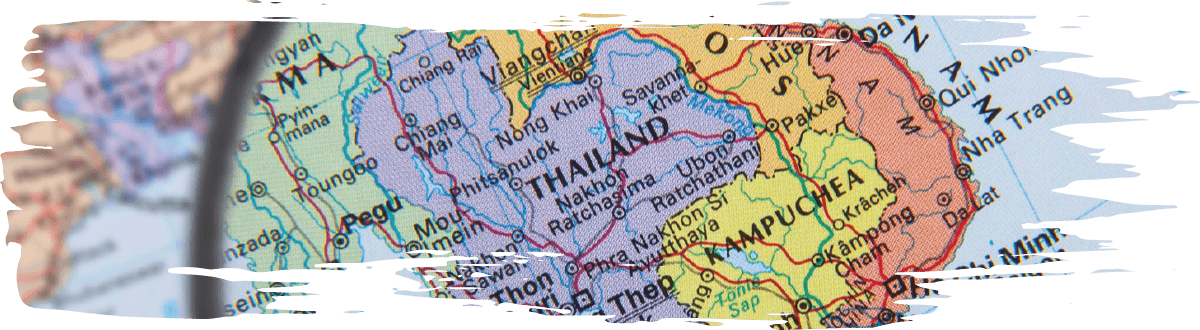
 Raw materials such as wheat, corn, soybean meal, and distillers’ dried grains with solubles (DDGS) are susceptible to infection by different mold species, meaning that when they are combined in finished feed, the resulting mycotoxin profile can be unusually diverse.
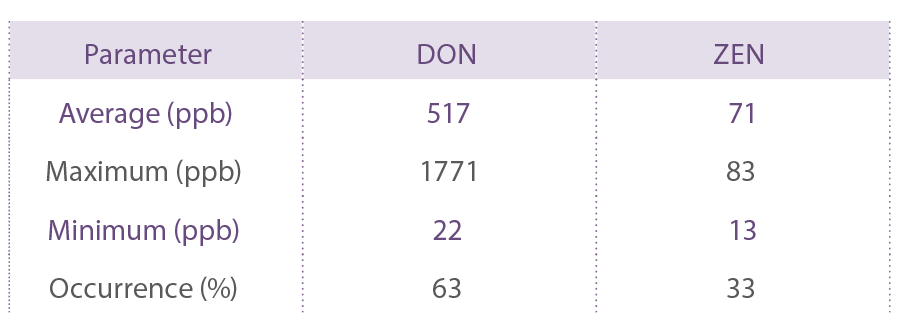
 Among wheat samples (Table 1):
 Deoxynivalenol (DON) was detected in 63 % of samples at an average concentration of 517 ppb. Zearalenone (ZEN) appeared in 33 % of samples at an average concentration of 71 ppb.

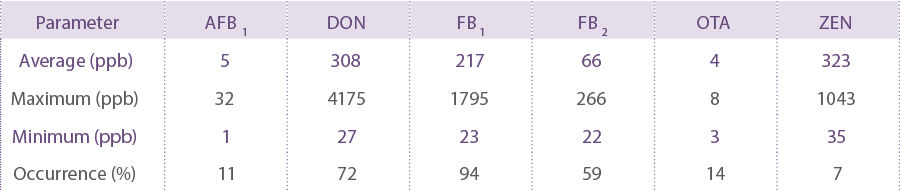
 Swine feed also did not escape the multi-mycotoxin contamination problem as a total of 87 % of finished feed samples contained more than one mycotoxin (Table 3):
AFB1 was present in 11 % of samples. DON was detected in 72 % of samples at an average concentration of 308 ppb. FB1 was detected in 94 % of samples at 217 ppb. OTA was detected in 59 % of samples at 4 ppb. ZEN, at an average concentration of 323 ppb, was detected in 7 % of samples.
 A sample may comply with the legal maximum levels for DON, ZEN, and OTA individually, yet the pig consuming that feed may be simultaneously exposed to all three mycotoxins in combination at levels that exceed the physiological tolerance of the animal.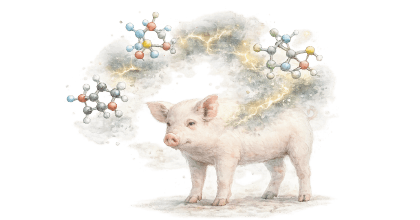
 This clearly summarizes the current situation: the co-occurrence of mycotoxins in feed raw materials and finished feed is the rule, not the exception.
 For practical decision-making at the farm level, this means that veterinarians, nutritionists, and purchasers should not only ask whether individual mycotoxin levels exceed guidance thresholds, but also how many mycotoxins are present and what the cumulative risk is for pig production.
 A feed simultaneously contaminated with AFB1, DON, and ZEN therefore requires a solution beyond what a clay binder alone can provide.
 A single mechanism is insufficient for the diverse multi-mycotoxin scenarios found in Southeast Asian swine feeds. This is the rationale behind multicomponent mycotoxin detoxifying agent (MMDA) products, which are specifically designed to address the breadth and complexity of real-world contamination.
 The range of mycotoxin combinations tested closely reflects the contamination patterns identified in the Thailand and Vietnam surveillance study under real-world conditions.
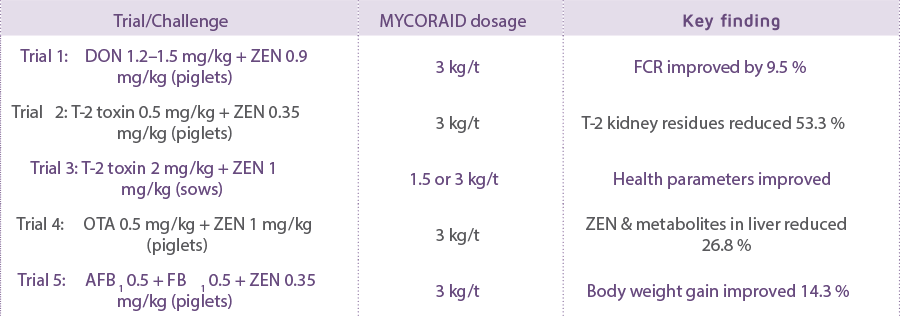
 The pattern emerging from these trials is consistent: supplementation with 3 kg of MYCORAID per ton of feed resulted in significant improvements in growth performance.
 Raj et al. (2025) documented that MYCORAID supplementation improved average daily gain, FCR, and reduced DON kidney residues in weaned pigs exposed to DON and ZEN.An earlier study also demonstrated the in vivo efficacy of the MYCORAID approach in reducing ZEN and T-2 tissue residues in piglets (Raj et al., 2020).The complexity of the contamination problem demands an equally complex solution.
 The demonstrated 14.3 % improvement in body weight gain in a triple-mycotoxin challenge scenario (AFB1 + FB1 + ZEN) translates directly into fewer days to reach market weight, improved feed conversion, and better economic returns.
A 53 % reduction in T-2 kidney residues and a 27 % reduction in hepatic ZEN and metabolites not only protect animal health but also contribute to food safety assurance. This represents a practical advantage in a region where contamination profiles vary according to ingredient, season, and geography.
 The synergistic effects of mycotoxin combinations undermine performance, health status, and food safety beyond what any single-mycotoxin threshold can address.
 Veterinarians, nutritionists, and feed millers operating in this region should incorporate routine multi-mycotoxin monitoring into their risk management programs, interpret results based on the full mycotoxin profile using LC-MS/MS rather than occasional testing of individual components, and ensure that protection strategies deploy the full mechanistic range.
20/05/26
Multi-mycotoxin risk in Southeast Asia and effective detoxification strategies in modern swine production


The impact of multi-mycotoxins on swine production and detoxification strategies to reduce health risks and production losses.
 DDGS, a by-product of the bioethanol industry increasingly used as a cost-effective protein and energy source in Southeast Asian swine feeds, showed the highest level of contamination (Table 2), with 91 % of samples containing more than one mycotoxin:
These findings demonstrate that MYCORAID intervention not only lowers the functional impact on the living pig but also reduces the potential for mycotoxin carry-over into the food chain.
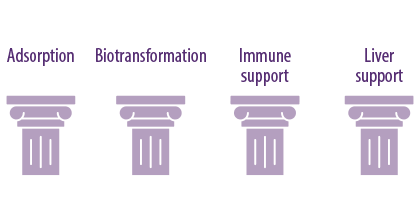
This four-pillar synergistic approach more accurately reflects the multidimensional nature of mycotoxin toxicity than any single-mechanism binder.
 Micotoxicosis prevention