

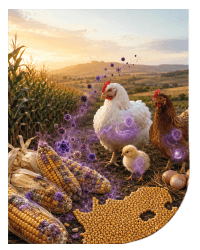



In the 2025 corn harvest in South Africa, the co-occurrence of mycotoxins was observed in all samples, meaning that each sample contained more than one mycotoxin. In South Africa, corn is a key raw material for animal feed, and its exposure to fungi in the field and during storage creates a continuous risk of contamination with Fusarium- and Aspergillus-derived metabolites.
 This is highly relevant because poultry are rarely exposed to a single toxin under commercial conditions. Instead, they consume complex mixtures that may have additive or synergistic effects, even when the concentrations of individual mycotoxins appear moderate.
In corn from South Africa, the predominant mycotoxins detected were: DON and ZEN are better studied, but they also interact with other contaminants and can impair performance even at concentrations below those that would cause acute clinical signs

Las micotoxinas emergentes, como la BEA y la FA, no siempre se incluyen en los controles rutinarios de los piensos, pero su presencia es importante porque pueden contribuir a: El DON y la ZEN son sustancias mejor estudiadas, pero también interactúan con otros contaminantes y pueden afectar al rendimiento incluso en concentraciones inferiores a las que provocarían signos clínicos agudos.
 Irritación intestinalEstrés oxidativoAlteración de la función celularMayor sensibilidad a otras toxinas
Table 1. Mycotoxin contamination in corn samples from South Africa in 2025. SOUTH AFRICAN MYCOTOXIN CO-CONTAMINATION COMPROMISES POULTRY IMMUNE FUNCTION For poultry and ruminants, the risk was assessed as moderate, whereas pigs and aquaculture species were classified as being at high risk.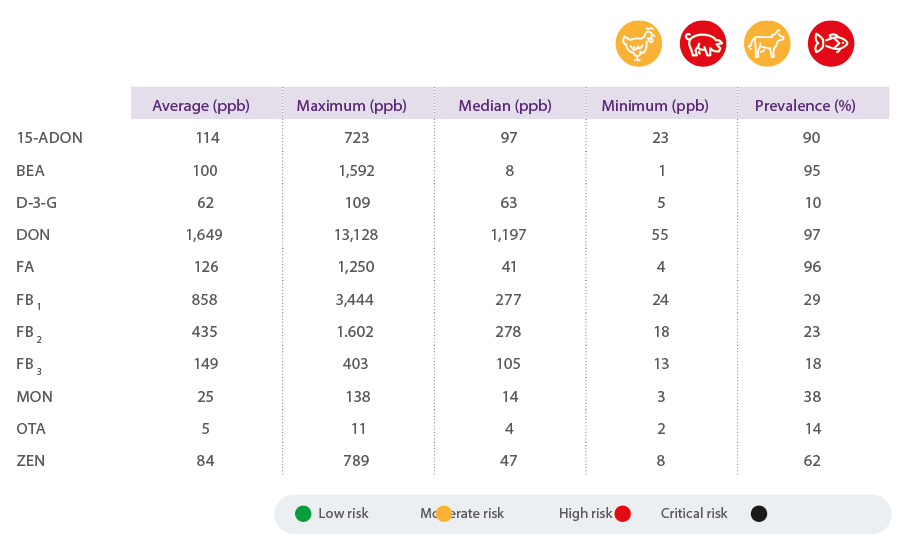
This does not mean that poultry can be ignored! Broilers, layers, and breeders are highly susceptible to subclinical disturbances in feed intake, gut integrity, immune response, liver function, and nutrient utilization.A moderate risk in poultry can still translate into considerable economic losses because modern birds have high genetic potential and limited physiological reserves.Small reductions in feed intake, body weight gain, laying rate, eggshell quality, or vaccine response can quickly affect flock profitability.
DON is primarily associated with: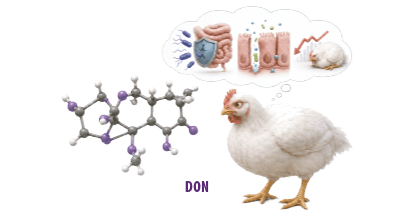
 Reduced feed intakeImpaired gut barrier functionCompromised villus integrityPoor nutrient absorption
Although poultry are more tolerant of DON than pigs, broilers exposed to DON contaminated diets may exhibit impaired performance, increased intestinal permeability, and greater susceptibility to enteric challenges.
ZEN is best known for its estrogenic effects. Although poultry are less sensitive to ZEN than swine, it should not be ignored in breeders and laying hens, for which reproductive efficiency, egg production, and eggshell quality are key economic parameters. Fusaric acid can contribute to reduced feed intake and may intensify the effects of other Fusarium toxins. Beauvericin is an emerging mycotoxin with cytotoxic and ionophoric properties, and its co-occurrence with DON, ZEN, or fumonisins may increase the biological burden on the gut and immune system.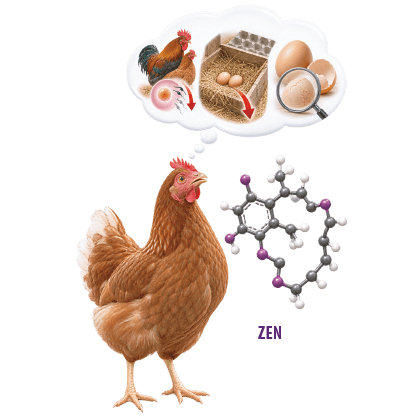
MYCORAID: MULTILAYERED SUPPORT DURING MYCOTOXIN CHALLENGES
MYCORAID was developed as a multilayered mycotoxin management solution combining specially selected minerals, microbial components, yeast cell wall fractions, and plant extracts. This approach is important because the South African contamination profile is not dominated by a single toxin.
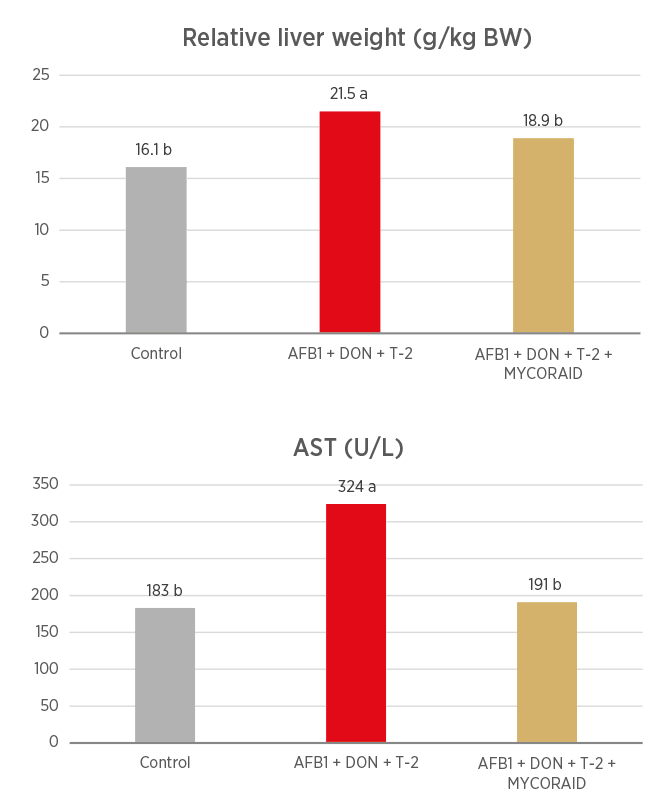
Trials with MYCORAID are especially relevant to markets such as South Africa, where feed contamination is characterized by the co-occurrence of multiple mycotoxins. In an Indian broiler trial involving a combined challenge with aflatoxin B1, DON, and T-2 toxin, mycotoxin exposure increased relative liver weight and aspartate aminotransferase (AST) levels. Mycotoxin exposure causes hepatocellular damage, inflammation, and cellular degeneration, leading to liver enlargement and the release of AST into the bloodstream. ⇒ Increased liver weight and elevated AST levels therefore indicate mycotoxin-induced liver stress and impaired hepatic function. MYCORAID helped normalize liver enzyme activity, improved the immune response (Figures 1 and 2) and supported liver resilience during the combined mycotoxin challenge. Figures 1 and 2. MYCORAID alleviates the damaging effects of a mycotoxin mixture on the broiler liver (India, 2021).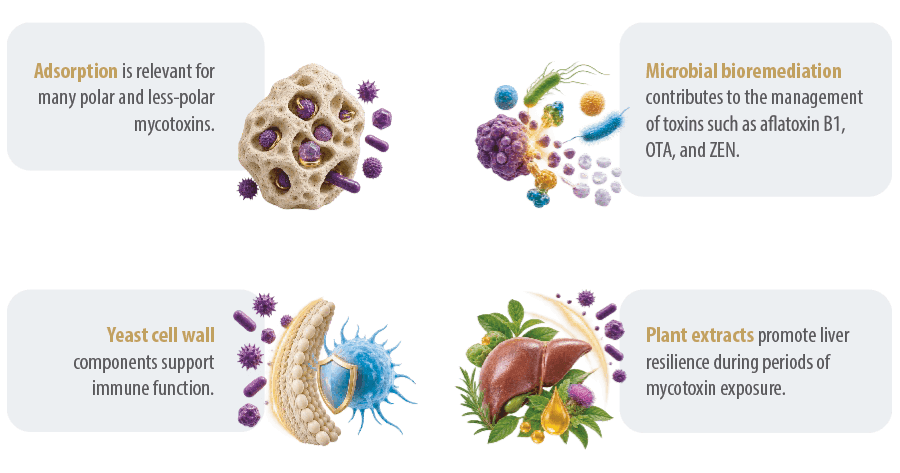
CONCLUSIONS South African corn samples should be considered a multi-mycotoxin challenge rather than a single-toxin problem. In poultry, such contamination can compromise gut health, immunity, liver function, performance, and egg-related parameters. However, clinical signs may be absent, making routine feed analysis and the risk-based application of mitigation products essential. The predominance of BEA, DON, FA, and ZEN, combined with their occurrence in every sample, indicates a complex Fusarium-driven risk profile.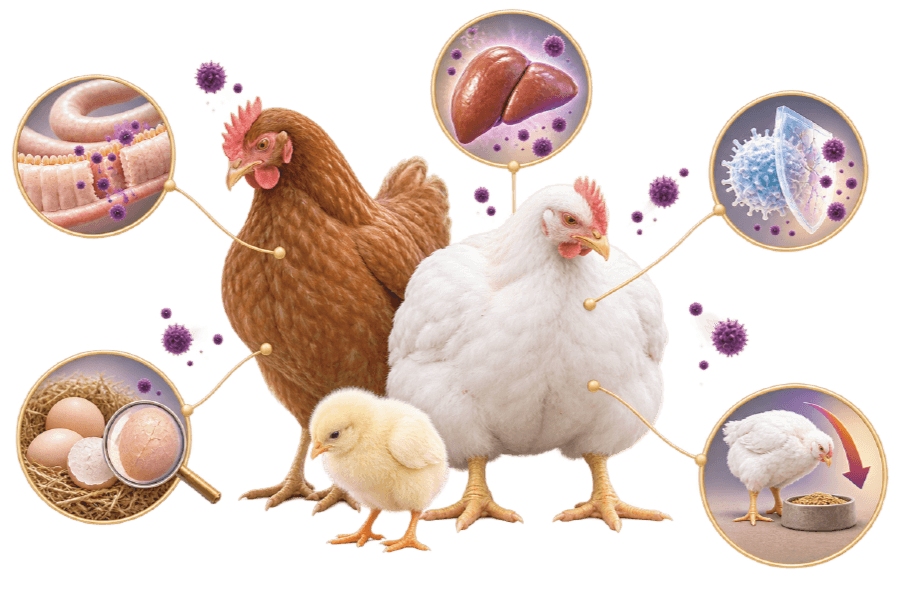
MYCORAID offers a practical strategy for addressing this challenge by targeting mycotoxin risk through multiple mechanisms: For South African poultry producers using corn-based diets, MYCORAID provides a relevant tool for maintaining performance and resilience under moderate but complex mycotoxin pressure.
 Micotoxicosis prevention