

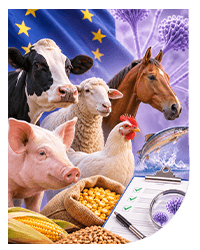



In July 2026, the European Commission adopted Commission Recommendation (EU) 2026/1801, introducing updated guidance values for the major mycotoxins in animal feed:

The recommendation reflects more than a decade of new occurrence data and scientific risk assessments from the European Food Safety Authority (EFSA), replacing previous recommendations from 2006 and 2013. The new recommendation provides stricter guidance levels for many mycotoxins. For some animal species and categories, it defines guidance levels for certain mycotoxins for the first time.
REGULATIONS OFTEN PLAY CATCH-UP WITH SCIENCE Mycotoxins continue to pose a significant risk to animal health and, indirectly, to food safety through their potential transfer into products of animal origin. Since the original guidance values were established, EFSA has published a series of updated scientific opinions identifying adverse effects at lower exposure levels in several animal species. The Commission therefore concluded that the existing guidance values no longer fully reflect current scientific knowledge and should be revised to ensure a high level of animal health protection. In particular, newer assessments have led to lower health-based reference points for poultry, horses, ruminants and other sensitive species.
SO, WHAT EXACTLY HAS CHANGED? Guidance levels for some mycotoxins were lowered, indicating that they are more toxic than previously thought.
In recent years, considerable new data have become available on the effects of fumonisins, especially in poultry. This change was introduced because of the negative effects that fumonisins exert on the intestinal health of chickens. Levels for DON in feed materials were reduced from 8 to 4 ppm in cereals and from 12 to 8 ppm in maize.
 In complete feed for pigs, the previous level of 0.9 ppm was reduced to 0.7 ppm.
 In aquaculture, an especially large adjustment was made, with the guidance level decreasing from 5 to 0.5 ppm in complete feed: a 10-fold reduction.
 As a result, fumonisin levels were reduced from the very high level of 60 ppm for maize and maize products to 40 ppm for maize products and 20 ppm for maize grain.
 For complete feed, the biggest change was seen in poultry other than turkeys and ducks, with a 10-fold decrease from 20 to only 2 ppm.The guidance level was also changed for pigs, decreasing from 5 to 1 ppm.
 Ruminants were traditionally considered resistant to fumonisins, but the levels were also made stricter for calves, lambs and kids (10 ppm instead of 20 ppm) and adult ruminants (30 ppm instead of 50 ppm).Levels for complete feed in aquaculture were reduced from 10 to 5 ppm.
Guidance levels for OTA were reduced in many feed materials from 0.25 to 0.05 ppm. Instead of a general level for complete feed (0.25 ppm), guidance levels for T-2 and HT-2 toxins have become more granular. The levels for complete feed are: ZEN guidance levels decreased from 2 to 1 ppm in cereals and from 3 to 2 ppm in maize products. New guidance levels were provided for complete feed for:
In complete feed, levels decreased from 0.1 to 0.03 ppm in poultry and from 0.05 to 0.01 ppm in pigs. Levels were newly defined for ruminants (0.02 ppm) and aquaculture (0.05 ppm).
0.2 ppm for pigs.0.5 ppm for laying hens and 0.1 ppm for other poultry. 0.05 ppm for sheepand 0.2 ppm for other ruminants.0.5 ppm for aquaculture.
Poultry (2 ppm).Cattle for fattening (1 ppm).Aquaculture (0.3 ppm).
Table 1. Comparison of old and new EU guidance levels for mycotoxins in feed (ppm).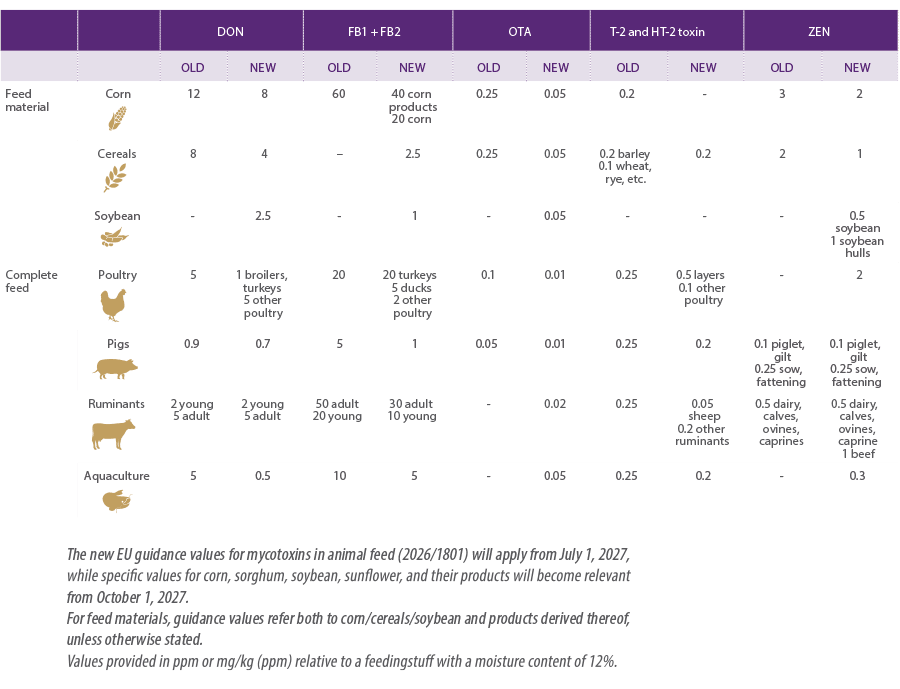
STRONGER EMPHASIS ON MONITORING
The recommendation calls on Member States and feed business operators to strengthen monitoring programs for these key mycotoxins. Importantly, laboratories are encouraged to analyze samples simultaneously for multiple mycotoxins, enabling a better understanding of co-occurrence, which is increasingly recognized as a major risk in practical feed production. The new recommendation places significant responsibility on feed manufacturers and farmers. When guidance values are exceeded, operators are expected to: The Commission also highlights the need for greater transparency along the supply chain. Suppliers of feed materials are encouraged to provide sufficient information on mycotoxin contamination to compound feed manufacturers, helping them formulate feeds that remain safe for the most sensitive animal species. The updated guidance values should be incorporated into HACCP systems and used to establish critical limits for controlling mycotoxin risks.
FINAL THOUGHTS The new guidance values will apply from July 1, 2027, while specific values for corn, sorghum, soybean, sunflower, and their products will become relevant from October 1, 2027. ⇒ From that date, the previous recommendations from 2006 and 2013 will be replaced. Recommendation (EU) 2026/1801: Source: https://eur-lex.europa.eu/eli/reco/2026/1801/oj

 Micotoxicosis prevention